
View photos on Gallery page
Humble Beginnings
Manilla began in the now-abandoned town of Astor, Iowa in 1885. Railroad officials arrived one summer—they were looking for a place to continue their expansion westward through Iowa and into South Dakota. Word quickly spread throughout Astor that the railroad had plans to build a new settlement, just two miles east of their town. The Chicago, Milwaukee, & St. Paul Railroad, as it was known back then, bought W. Les Paup's farm, had it surveyed, and lots were staked out. $13,000 worth of lots were sold during the initial auction, and a new community sprang up practically overnight. The residents of Astor, primarily German in descent, packed their home and business essentials on wheels and carted over to the new town. The strenuous moving process involved the use of livestock like horses, mules, and oxen to pull heavy carts.
Upon arrival, the townspeople lined up along what would be their new Main Street with corn stalks and fodder under their feet. Even with their stores still on stilts, the people were ready for business. Astor's two blacksmiths, Palmer and Brown, were the first to leave the old town and move their businesses with them. Their services were necessary for the construction of the new railroad, which required a significant amount of materials and equipment. E.H. Hanne was the first to move his grocery store to the town—his business was located where Memorial Hall stands in Manilla present day.
All the meanwhile, the new town didn't even have an official name. At the annual 4th of July celebrations in Astor, one popular tradition among the community was tug-of-war. So, it was decided that year that the town's name would be decided by a tug-of-war contest. There were some in the community who thought it should be named Paupville (after Les Paup, who sold the town's land to the railroad). For the story behind the alternative option, and the name of the town we know today, things got a little more creative.
Around this time, Blackburn's Hardware Store in Astor had been sending out circulars advertising a new self-binding twine called Manila twine. This twine was a special type of twine made from hemp fiber that was exported from Manila in the Philippines. Blackburn furnished a Manila rope from the twine for the game and suggested the new town be named Manila. If you're curious how Manilla got the second 'L' in its name, that questions till remains a mystery. The change was almost certainly intentional, and seems to have happened during the official recording of the town name.
Some of those pulling for the Manilla name in the match were Cash Crakes (father to Grace Schram), Ad Morgan (father to Cicero Morgan), Luke Tillet, and Charley Schroeder. A few that were pulling for Paupville included Ed Saunders (father to Harry Saunders), Charles Saunders (father to Chuck Saunders), and Will Theobald (father to Ed Theobald).
After the contest was over and the town's name had been chosen, the residents of now-called Manilla furnished a slogan for their town. In honor of that fateful match of tug-of-war, people began reffering to Manilla as,"The town people pull for!".
The postmaster in Astor resigned after nearly all the town's residents had moved to Manilla. The post office in Manilla was established at the official opening of the town in 1886, and its first postmaster was G.W. Brokaw.
Manilla Starts to Grow
With several homes and businesses already in place, some community members pooled their funds and purchased lots to build new churches in Manilla. These churches were the Presbyterian Church and the Methodist Church, respectively. When it came time to build a school, however, there were some setbacks. Initially, there wasn't enough money in the treasury to fund a school building, so the Presbyterian church was leased during the week instead. Two teachers were hired to instruct classes on either side of the church, with a curtain separating the two of them.
Dr. J.G. Gardner has been regarded by some as the 'Father of Manilla'. Gardner moved to Manilla in 1887 and operated within Westbrook's Drug Store in town, which was owned by C.H. Westbrook. Besides being known as Manilla's first local doctor, Gardner is also celebrated for the twenty five homes that he erected in Manilla during his lifetime.
Approaching late 1887, the town had amassed a population of over 800 residents, and Manilla became known as somewhat of a railroad center. The town boasted a roundhouse with 12 locomotive stalls, costing a total of $50,000. Foreman J.R. Miller employed 15 Manilla men to service and repair the trains that came through the town. M.N. Smith owned the first hotel in Manilla, which was known as the Union Hotel. The building could house up to 35 people at any given time. The first local newspaper was called the Manilla Register, and it was operated by the Baer family. Mr. Baer was the editor, and Mrs. Baer set most of the type—this was a tedious process that involved 'setting' individual letters into a handheld frame to form words, then press them onto the print paper.
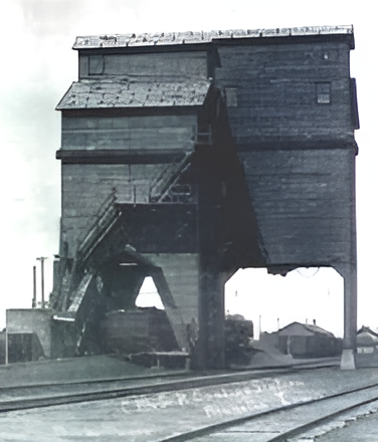
Manilla's coaling station (enhanced photo)
As Manilla continued to grow, many in the town believed there was an increasing need for autonomy and order within the community. At the September term of District Court in 1887, the judge appointed T.J. Garrison and E.K. Burk of Denison, as well as A.L. Barrett, F.S. Garleck, and G.W. Baer of Manilla to hold a vote that would profoundly impact Manilla's future. In early October, by a vote of 93 to 13, the people of Manilla decided they would incorporate their community, meaning local government among other things would be put into place. I.W. Callimore was elected as Manilla's first mayor.
A Small Boomtown
Nearing the turn of the 20th century, there were well over 200 families living in Manilla. The now self-proclaimed city was flourishing under its new government system, and the railroad continued to drive the community's economy. On average, four passenger trains and eighteen freight trains passed by Manilla each day. The city now had two new hotels to board the visitors and travelers that the trains brought in. These hotels were known as the Depot Hotel and the Klondike Hotel—both of which were two-story frame buildings with 15 rooms each. The Klondike Hotel still stands as a historical landmark in Manilla present day, having recently been renovated in (2014?).
In addition, the city's first public school had been finished; it was also a two story building that held over 330 students in its first year. Professor S.W. Meyers was the lead instructor at the school assisted by five other teachers. Manilla also went from having two to now four churches, with the consutrction of the Catholic and Lutheran churches.
Beyond community essentials, the city had amassed a multitude of businesses, services, and attractions within its first 10 years. Most notably, there was a bank, two drug stores, a clinic, two hardware stores, a general goods store, a furniture store, a grocery store, two restaurants, a bar, as well as various other types of vendors and tradespeople.
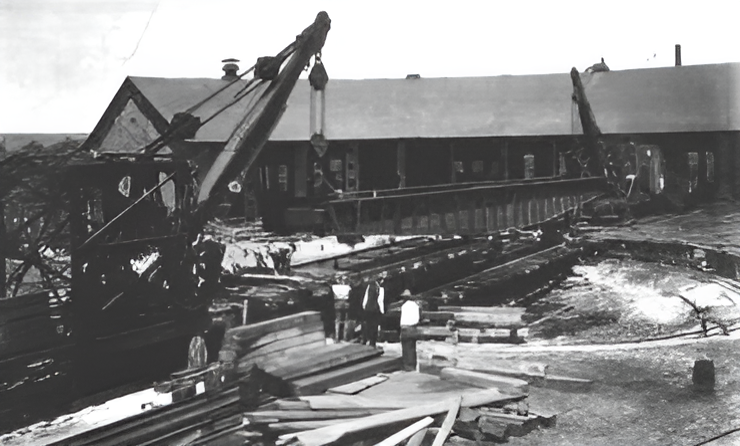
Manilla's railway turntable being built, circa 1900 (enhanced photo)
Post-Railroad and Present Day
Manilla never became the booming railroad center that the Milwaukee Co. had intended due to a decision ruled by the Interstate Commerce Commission (ICC). However, that's not to say that Manilla was just another rural community with a railroad running through it. Because of its location as a junction point, Manilla was an essential railroad center to the company. In 1911, the Chicago, Milwaukee, and St. Paul Railroad Company named one of its Pullman cars "The Manilla" in honor of the city.
As time went on, the increased production and use of automobiles for travel and transpotation of goods signaled the end of the 'golden age' for Milwaukee Co. and the other railroad giants. As such, Manilla transitioned over time from a railroad community to an agriculture based community. Farmers, ranchers and seed companies are just a few of the businesses that compliment Manilla's strong agricultural identity present day.
We still honor our railroad heritage in more ways than one. Our city is home to more than a few historical museums, homes, photos, and other memorobilia. A Milwaukee Road caboose museum is located uptown in Bandshell Park, and there are multiple town landmarks depicting locomotives, including the city entrance sign, Manilla mural, and city 'statue'.
Manilla today is one of Iowa's most tranquil and neighborly cities. Beyond the city's rich railroad and agricultural history, Manilla is also admired for its dynamic culture as well as the scenic countryside surrounding the city. Quickly approaching its 140th anniversary, Manilla is a shining example of a city that continues to evolve and prosper.
Credit to Author(s) - IA GenWeb Project
Much of the information in this page has been directly quoted, paraphrased, or otherwise borrowed from the Iowa GenWeb Project's publication on Manilla's early history. Please view the original article by clicking here if you're interested in more details that are not included in this page!